

The Model Doesn’t Lie
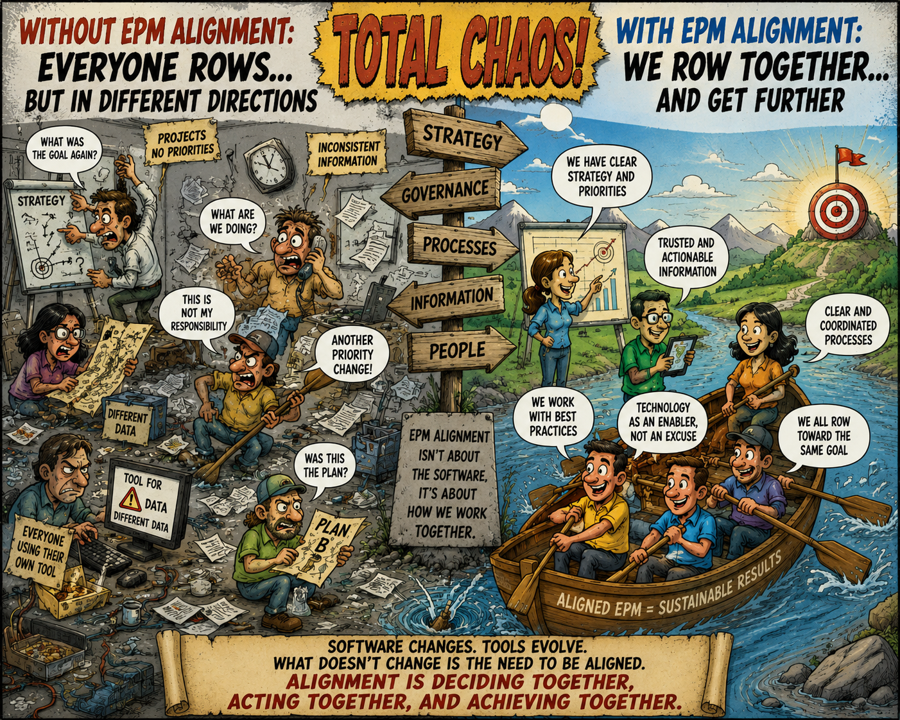
How EPM implementation uncovers the underlying misalignment that traditional presentations often obscure for extended periods.
A Florida retail chain with two brands and about 80 stores, operating across multiple channels, had its executive committee approve a project to build a category-level profitability model. The decision was unanimous, with all twelve members in agreement and no objections. The project sponsor presented it to the board as a perfect example of consensus.
Fourteen weeks into the project, during the build phase, the CFO entered the project room as the team was adding fulfillment and last-mile costs to the electronics category. The CFO said, “This isn’t what we approved.” The VP of Merchandising responded, “It’s exactly what we approved.” Both perspectives were valid. Although they had signed the same memo, each envisioned a different model. The CFO believed he was approving gross margin by category from the general ledger, whereas the VP understood it as contribution margin with cost-to-serve allocated by activity-based costing (ABC).
The company identified this issue only in week 14, although it could have been detected as early as week 2 without incurring additional costs. This oversight resulted from a common mistake, referred to as “false alignment” in recent Boston Consulting Group research published in Harvard Business Review. The study examined the reasons behind transformation failures and found that, among nearly 2,000 companies, over 70% failed to outperform their industry average following a downturn, regardless of the time frame considered. Despite major advancements in technology and data, organizations continue to face challenges in achieving genuine executive alignment.
In EPM projects, such failures typically originate from misaligned definitions rather than technological shortcomings. The committee often assumes joint understanding where there is none. Three key questions can help differentiate models that guide decision-making from those that merely reconcile figures:
- Why does a committee approve ‘better planning’ without realizing that each member has agreed to a different model?
- Why does the data model disclose this gap so late, and what is the cost of that delay?
- How can you settle the definitions early rather than waiting for the build phase to force the issue?
Identical terminology may carry divergent meanings for different stakeholders
False alignment is not about dishonesty; it is a cognitive bias. The BCG research connects it to the false consensus effect, described by Lee Ross and his Stanford team: we tend to overestimate how many people share our views. A Harvard decision scientist explained it simply: if she loves vanilla ice cream, she will keep thinking most people do too. In the C-suite, this means an executive who supports an initiative assumes everyone else supports it for the same reasons.
In finance, this ‘vanilla’ has a technical term: the confusion between FP&A and BP&A. When the committee approves ‘planning,’ the CFO considers financial statements, including the general ledger, IFRS, legal entities, and consolidation. The operating VP, on the other hand, focuses on business aspects such as capacity, cost-to-serve, and profitability by customer or category, using ABC. When someone says ‘profitability model,’ one person imagines profit by entity, while another thinks of contribution margin by managerial object. The words are the same, but the meaning is different.
The authors share a story that could start any EPM kickoff meeting. Two manufacturing executives both want to ‘improve the margin.’ One plans to raise prices, while the other wants to cut unit costs. Until they discuss the details, neither realizes they disagree, and neither gets to negotiate a solution. Because of the false consensus effect, this misunderstanding can last for months.
For the Florida retailer, those months of misunderstanding were costly. Our internal estimate indicated that reworking the master data would take about 9 person-weeks and delay the project launch by a full quarter. All of this happened because no one asked a simple question in week 2: Profitability of what? The lesson is clear. Approving ‘planning’ or ‘profitability’ without specifying the managerial objective is not real alignment. It is just postponing a disagreement that will eventually cause problems.
The data model provides objective clarity; the build phase ultimately enforces the decision the committee previously deferred
This characteristic distinguishes EPM implementation from other transformation initiatives and explains why model-driven projects are particularly susceptible to false alignment.
False alignment can remain concealed within presentations for extended periods, as ambiguity is easily sustained in formats such as PowerPoint. Expressions like ‘profitability model’ can be included in list items without calling for precise definition. However, ambiguity is untenable in a data model. The dimensional model operates as a formalized agreement, codified in system logic. Once dimensions, hierarchies, allocation drivers, and managerial objects are defined, pending questions must be addressed.
Consequently, the build phase effectively becomes the final decision-making forum that should have taken place during the design stage. This delay causes considerable costs, including change requests, scope disputes, and implementation consultants mediating between executives who are only now recognizing their conflicting expectations. EPM does not generate false alignment; rather, it exposes it, frequently at the most inopportune and costly moment.
BCG outlines three ways an execution team can fall apart when leaders never truly agreed, and each has a direct counterpart in a model project. Paralysis happens when the team builds prototype after prototype but never goes live because they cannot choose between different visions. Hyperactivity results in a model overloaded with every dimension requested by executives, leading to reports that exist only to satisfy individuals and are impossible to maintain. Tunnel vision occurs when a model is built for just one narrow interpretation, resulting in a perfect GL consolidation that reconciles exactly but does not answer any business questions.
The last scenario is the most dangerous because it appears successful. The model passes validation and exactly matches the general ledger, but does not actually guide any decisions. I repeat this point in every steering committee: validation shows the numbers add up, but governance shows you can rely on the model. These are not the same. A model built on false alignment can reconcile perfectly but still fail to provide real guidance.
The verdict before the build
The report offers good news: false alignment can be prevented, and the steps to reach real agreement fit well into the early stages of any implementation. The authors highlight the case of Alexander Lacik at Pandora, which is especially relevant for finance because he did not just fix a communication issue, he addressed a problem of definitions.
When Lacik became CEO in 2019, the Danish jewelry company had just endured a tough decade. In a single day in August 2011, it lost 65% of its market value, and four CEOs came and went over the next few years. The transformation plan was already in place, including a $400 million cost-reduction program. Lacik found 46 active priorities on his leadership team’s list. Instead of asking for more alignment, he gathered the team for two days with one rule: no one leaves until they narrow the list to 12 priorities with full commitment. He promoted open disagreement, reviewed each priority, and had the team vote on what to keep.
The agreement was grounded in a specific metric: growth was measured exclusively from end-customer demand, limited to stores open for more than 12 months, and including online sales. For FP&A or BP&A professionals, this represents a precise definition of a managerial object rather than a superficial slogan. This type of definition is often postponed in EPM projects until it results in considerable costs. Lacik addressed it prior to execution, rather than during implementation.
Apply this approach during your Analyze and Define stage. The equivalent of Pandora’s off-site is to address the FP&A versus BP&A differences during design, not during the build. Begin with a facilitated workshop in which all key stakeholders openly share their expectations for the model’s purpose and use. Use structured facilitation methods such as decision matrices or the RAPID framework to clarify who has input, who owns the outcome, and how decisions will be made. To make the process concrete, ask each function to write down its position on the costing method: ABC or full absorption, which driver, and which object. Have them do this individually and in writing, since independent writing helps prevent groupthink and exposes silent disagreements. Then, hold focused one-on-one discussions with each owner of a managerial object to clarify boundaries and resolve remaining ambiguities. Conclude with a workshop to review all positions as a group and negotiate a single shared definition. Finally, reach a formal, signed agreement on the dimensional model, treating it as seriously as signing a check. By signing off on the master data definition before the build, the data model becomes a useful tool instead of a source of conflict.
Three essential concepts and a practical action for immediate implementation
Here are three takeaways. First, in EPM, false alignment is not a communication risk, it is a definition risk that exists between FP&A and BP&A. Second, the dimensional model is what brings disagreements to light, and it always happens late if you wait until the build phase. Third, real agreement is either inexpensive at the beginning or costly at the end. There is no middle ground.
If you have an EPM project underway or about to begin, here is what you can do this week. Bring together the owners of your three key definitions: profitability, planning, and budget. Ask each person to write down, on a single page and by themselves, which managerial object they believe the model will produce. Do not let them discuss it first. Then compare their answers. If they differ, you have just identified, in an hour and at no cost, the same issue that took the Florida retailer nine weeks to uncover. Write down the agreed definition and have everyone sign it.
If the group cannot reach agreement after initial discussions, do not force a temporary compromise. Instead, escalate the dispute to a neutral executive sponsor or governance panel for a facilitated decision. Distill the points of disagreement and use structured decision-making models to help the team weigh the impact of each option. Acknowledge that reaching a true consensus may require additional workshops or even a formal vote, but only proceed when all members have a clear, shared definition. Preparing for this possibility keeps the process transparent and constructive, and prevents the project from stalling on unsettled differences.
Anticipating the next 12 to 24 months, as models become part of ERP systems and AI agents start handling planning, the temptation to ‘configure first, define later’ will only grow because the tools seem to handle ambiguity. They do not. The more automated the model, the sooner and more expensively false alignment will cause problems, since there is no longer a human consultant to bridge conflicting definitions. Settling definitions before the build is no longer simply good practice, it is the last line of defense. In highly regulated sectors like banking, where organizations such as the CNBV, SIB, and SBP require traceability for the managerial numbers behind decisions, a signed agreement on definitions is more than efficiency. It is becoming a governance requirement.
To sustain alignment as your business and technology landscape changes, put governance mechanisms in place that go beyond the initial sign-off. Establish a periodic review cycle, such as quarterly or semiannual definition audits, in which the core definitions underpinning your data models are revisited and formally reaffirmed or updated by the ownership group. Governance committees should watch for changes in strategy, reporting needs, or legal requirements that might affect key definitions. Documenting these reviews maintains an audit trail and prevents silent drift. Appointing a definition owner, or a cross-functional governance panel responsible for definition stewardship, sustains shared understanding and accountability over time. By making definition governance an ongoing discipline rather than a one-time event, you build resilience and transparency into your EPM processes and support project success as the organization grows.
